If, as Daniel Henninger observes in The Wall Street Journal, Barack Obama's is shaping up as
a radical presidency, akin to those of FDR and LBJ, the US may be in for a dramatic expansion of government power not seen since those Presidents.
Considering that it took about 40 years before a President came along who challenged and at
least tried to roll back some of that statism, maybe the GOP should start looking now for that "new Reagan" to roll back Obama's programs when the time comes. It would be a shame to waste another 40 years. Granted, Republicans who spend money hand over fist like they have under George W. Bush will not have the credentials for that task, and neither will have those Congressman and Senators who voted for the bailout. Rather, the GOP should look to those state level leaders who have consistently and courageously spoken out against the new programs, even when those would benefit their states... I speak of Governors like Mark Sanford (SC), Bobby Jindal (LA) or Mitch Daniels (IN).
Clearly, once it becomes clear the outrageous extension of the government's reach has failed, a new dawn for fiscal responsibility will come. The GOP would do well to position themselves now.
Wednesday, February 25, 2009

Monday, February 16, 2009
Is doing something always better than doing nothing?
There are a few things that surprise and trouble me about the current financial crisis. One is that it appears to be used by politicians everywhere as a pretext for an unprecedented power grab. Sure, they involve themselves in formerly relatively free markets very reluctantly, they say. But the more honest statement is probably that attributed to new White House Chief of Staff Rahm Immanuel, who said (and I paraphrase), "It would be a shame to let a crisis go to waste."
The other things that really disturbs me is the hybris of politicians who feel they can micromanage the economy. But it may well be argued that the global economy of today is such an intricate web of interdependencies, that we just do not know what an intervention in one area will cause elsewhere. The strange mantra appears to be that doing something, or anything, is better than doing nothing. But the hippocratic rule of "first, no harm" may oftentimes imply that nothing be done, because any course of action may be harmful.
I think human beings in general, and politicians in particular, have a hard time accepting that there are forces better not interfered with. And by meddling, they invariably make things worse.
It is unacceptable to many that boom times are sometimes interrupted by bust times, such as always been the case in the history of mankind. It is a fairly recent development that economists, politicians, and central planners have tried to smooth out the business cycle. Yet, despite (or actually because of) the efforts of the best and brightest, this has never worked.
Historians today are beginning to debunk some of the Great Depression myths. Central to their thesis that the government's activity under Hoover and FDR may actually have prolonged the depression is the idea that individuals and markets abhor uncertainty. Having an activist government that produces hectic new approaches to managing the economy on a weekly basis creates uncertainty and we are seeing some of that again today.
In the 1960s, bright young economists began tinkering with the economy in the expectation that they could tame the business cycle. Ultimately, this led to the disastrous economy of the 1970s.
Both the 1930s and the 1960s are clear examples of government and presumed experts overreaching. Unfortunately, people do not seem to have learned from these experiences. And today, more sinister motives may also lurk behind those advocating a bigger government role in managing the financial system: these are people who are free market sceptics anyway, who relish what they perceive as market failures, and who see a chance to roll back the policies of the 1980s and 90s. By not accepting the intermediate pain of a downturn, and by vastly expanding government expenditures to combat it, they are laying the groundwork for worse problems in the none too distant future. But hey, then it will merely be time for more government intervention, right?
The other things that really disturbs me is the hybris of politicians who feel they can micromanage the economy. But it may well be argued that the global economy of today is such an intricate web of interdependencies, that we just do not know what an intervention in one area will cause elsewhere. The strange mantra appears to be that doing something, or anything, is better than doing nothing. But the hippocratic rule of "first, no harm" may oftentimes imply that nothing be done, because any course of action may be harmful.
I think human beings in general, and politicians in particular, have a hard time accepting that there are forces better not interfered with. And by meddling, they invariably make things worse.
It is unacceptable to many that boom times are sometimes interrupted by bust times, such as always been the case in the history of mankind. It is a fairly recent development that economists, politicians, and central planners have tried to smooth out the business cycle. Yet, despite (or actually because of) the efforts of the best and brightest, this has never worked.
Historians today are beginning to debunk some of the Great Depression myths. Central to their thesis that the government's activity under Hoover and FDR may actually have prolonged the depression is the idea that individuals and markets abhor uncertainty. Having an activist government that produces hectic new approaches to managing the economy on a weekly basis creates uncertainty and we are seeing some of that again today.
In the 1960s, bright young economists began tinkering with the economy in the expectation that they could tame the business cycle. Ultimately, this led to the disastrous economy of the 1970s.
Both the 1930s and the 1960s are clear examples of government and presumed experts overreaching. Unfortunately, people do not seem to have learned from these experiences. And today, more sinister motives may also lurk behind those advocating a bigger government role in managing the financial system: these are people who are free market sceptics anyway, who relish what they perceive as market failures, and who see a chance to roll back the policies of the 1980s and 90s. By not accepting the intermediate pain of a downturn, and by vastly expanding government expenditures to combat it, they are laying the groundwork for worse problems in the none too distant future. But hey, then it will merely be time for more government intervention, right?
Wednesday, September 19, 2007
Wonderful, wonderful Copenhagen


Just to get back in the groove of posting, here are a few pics from our recent long weekend in Copenhagen, truly a wonderful city.
Monday, June 18, 2007
The Hedgehog and the Fox
I'm not sure how many of you out there are familiar with the philosopher Isaiah Berlin..actually, I can't say I'm familiar with him myself, I keep mixing him up with the composer Irving Berlin is all I can say.
But he (Isaiah B.!) is credited with an essay that in turn is based on an ancient Greek fragment, "the fox knows many things, but the hedgehog knows one big thing." Berlin applied this nugget of wisdom to the world of writing and thinking, dividing famous poets and philosophers into two categories:
foxes, who divide their interests among a wide variety of experiences and thoughts and who can't be associated with a single big idea, and hedgehogs, whose view of the world is founded on such a single big idea.
In Berlin's view, examples of hedgehogs include Dante, Plato, Lucretius, Pascal, Hegel, Dostoevsky, Nietzsche, Ibsen, and Proust, whereas Shakespeare, Herodotus, Aristotle, Montaigne, Erasmus, Molière, Goethe, Pushkin, Balzac, and Joyce are represented as foxes.
In the field of politics, my contribution would be that U.S. presidents Carter and Reagan also symbolize those two categories, with Carter a typical micro-manager who famously even involved himself in the scheduling of the White House tennis court, being a prototypical fox, and Reagan, who focused his Presidency on a few major goals ("lower taxes", "defeat communism"), set the agenda and then leaned back and let his staff do the work, standing out as a typical hedgehog.
Now, my literary and philosophical knowledge is not sufficient to analyse how fitting Berlin's categorizations are. The political example shows that you may expand the original saying somewhat to say "the hedgehog focuses on a few big things". The point I want to make is that all of us human beings have to deal with getting through this life successfully, given a limited set of ressources. And those who single-mindedly invest those ressources into a single goal or interest (the "hedgehogs") will likely go farther in that field than those who spread their ressources and interests far and wide (the "foxes"). Conversely, while they may end up more successful in their chosen field, the hedgehogs miss out on many of the joys of dabbling in various hobbies, interests and domains.
Still, the idea of hedgehogs being "better" or "wiser" than foxes (or vice versa) is certainly not true. Rather, as in many things, there has to be a "goodness of fit" among the individual's thinking style and his environment. There will be situations where it is adaptive to juggle many things simultaneously, whereas other situations may demand focus on one or two big issues. From a lifespan perspective, it would seem foolish to focus on too few things too early in life, before you had a chance to sample a wider selection of options and interests. Then, as life goes on, it may indeed be wise to focus on a few ideas and concepts that have turned out to make sense to you. Another possibility is that we need to be focused and goal-driven in our professional pursuits, while it will enhance our personal growth to have many interests in the private domain.
So, whether you see yourself as a fox or a hedgehog...or maybe as a mix of the two, I hope you have enjoyed these ramblings. Comments are always appreciated.
But he (Isaiah B.!) is credited with an essay that in turn is based on an ancient Greek fragment, "the fox knows many things, but the hedgehog knows one big thing." Berlin applied this nugget of wisdom to the world of writing and thinking, dividing famous poets and philosophers into two categories:
foxes, who divide their interests among a wide variety of experiences and thoughts and who can't be associated with a single big idea, and hedgehogs, whose view of the world is founded on such a single big idea.
In Berlin's view, examples of hedgehogs include Dante, Plato, Lucretius, Pascal, Hegel, Dostoevsky, Nietzsche, Ibsen, and Proust, whereas Shakespeare, Herodotus, Aristotle, Montaigne, Erasmus, Molière, Goethe, Pushkin, Balzac, and Joyce are represented as foxes.
In the field of politics, my contribution would be that U.S. presidents Carter and Reagan also symbolize those two categories, with Carter a typical micro-manager who famously even involved himself in the scheduling of the White House tennis court, being a prototypical fox, and Reagan, who focused his Presidency on a few major goals ("lower taxes", "defeat communism"), set the agenda and then leaned back and let his staff do the work, standing out as a typical hedgehog.
Now, my literary and philosophical knowledge is not sufficient to analyse how fitting Berlin's categorizations are. The political example shows that you may expand the original saying somewhat to say "the hedgehog focuses on a few big things". The point I want to make is that all of us human beings have to deal with getting through this life successfully, given a limited set of ressources. And those who single-mindedly invest those ressources into a single goal or interest (the "hedgehogs") will likely go farther in that field than those who spread their ressources and interests far and wide (the "foxes"). Conversely, while they may end up more successful in their chosen field, the hedgehogs miss out on many of the joys of dabbling in various hobbies, interests and domains.
Still, the idea of hedgehogs being "better" or "wiser" than foxes (or vice versa) is certainly not true. Rather, as in many things, there has to be a "goodness of fit" among the individual's thinking style and his environment. There will be situations where it is adaptive to juggle many things simultaneously, whereas other situations may demand focus on one or two big issues. From a lifespan perspective, it would seem foolish to focus on too few things too early in life, before you had a chance to sample a wider selection of options and interests. Then, as life goes on, it may indeed be wise to focus on a few ideas and concepts that have turned out to make sense to you. Another possibility is that we need to be focused and goal-driven in our professional pursuits, while it will enhance our personal growth to have many interests in the private domain.
So, whether you see yourself as a fox or a hedgehog...or maybe as a mix of the two, I hope you have enjoyed these ramblings. Comments are always appreciated.
long time no blog
goodness how time flies! i guess i was waiting to see if anyone missed me. haha. anyway, i'm back and i'll try to post a few new mumblings and musings every now and then, even if only for myself :-)
Wednesday, July 05, 2006
Sardinia, baby!
While I'm a little torn about the ecological implications of cheap air travel, I'll have to admit that it's great being able to hop on a plane and get yourself flown in no-frills style to some nice place at a reasonable cost.
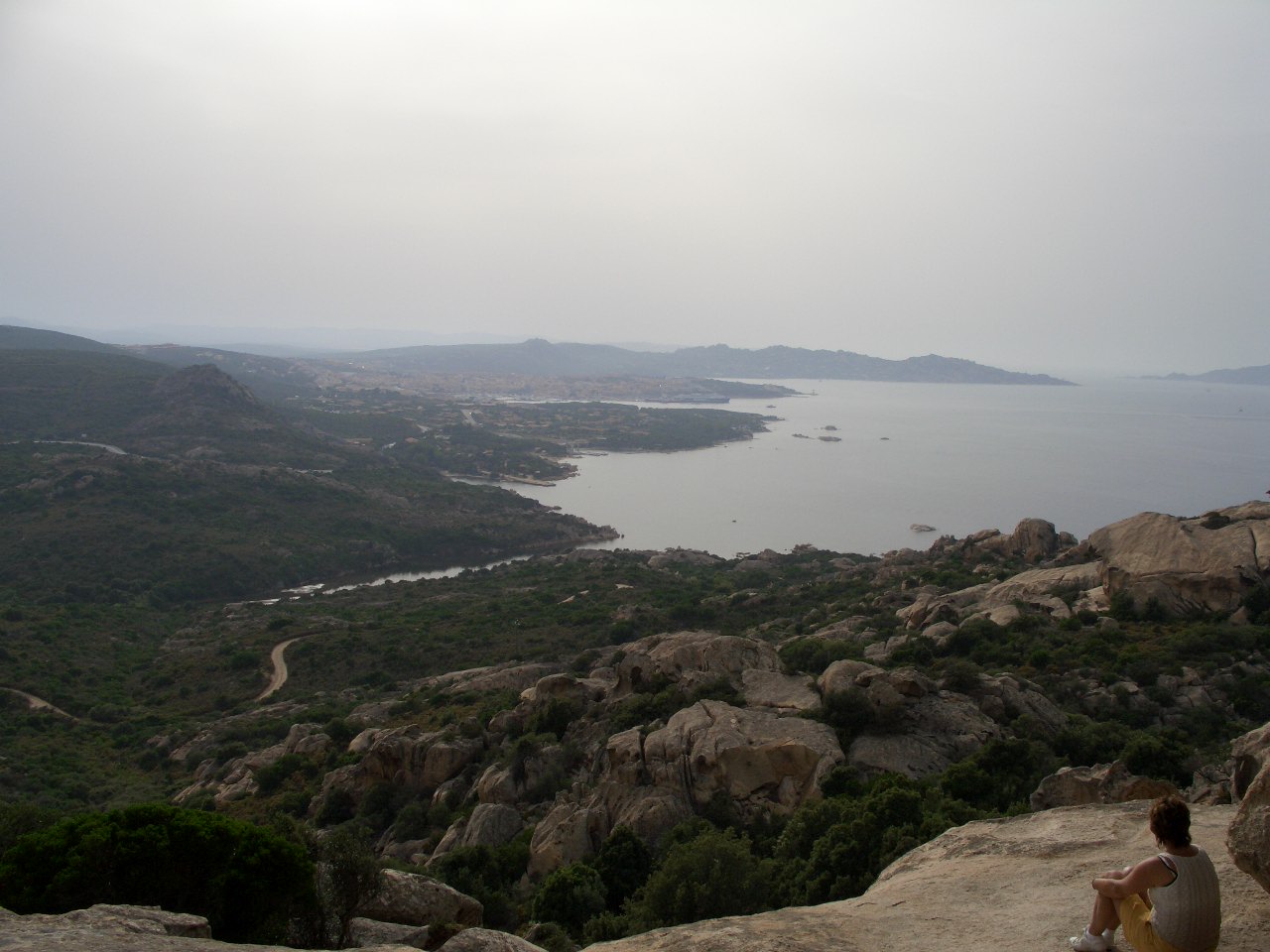
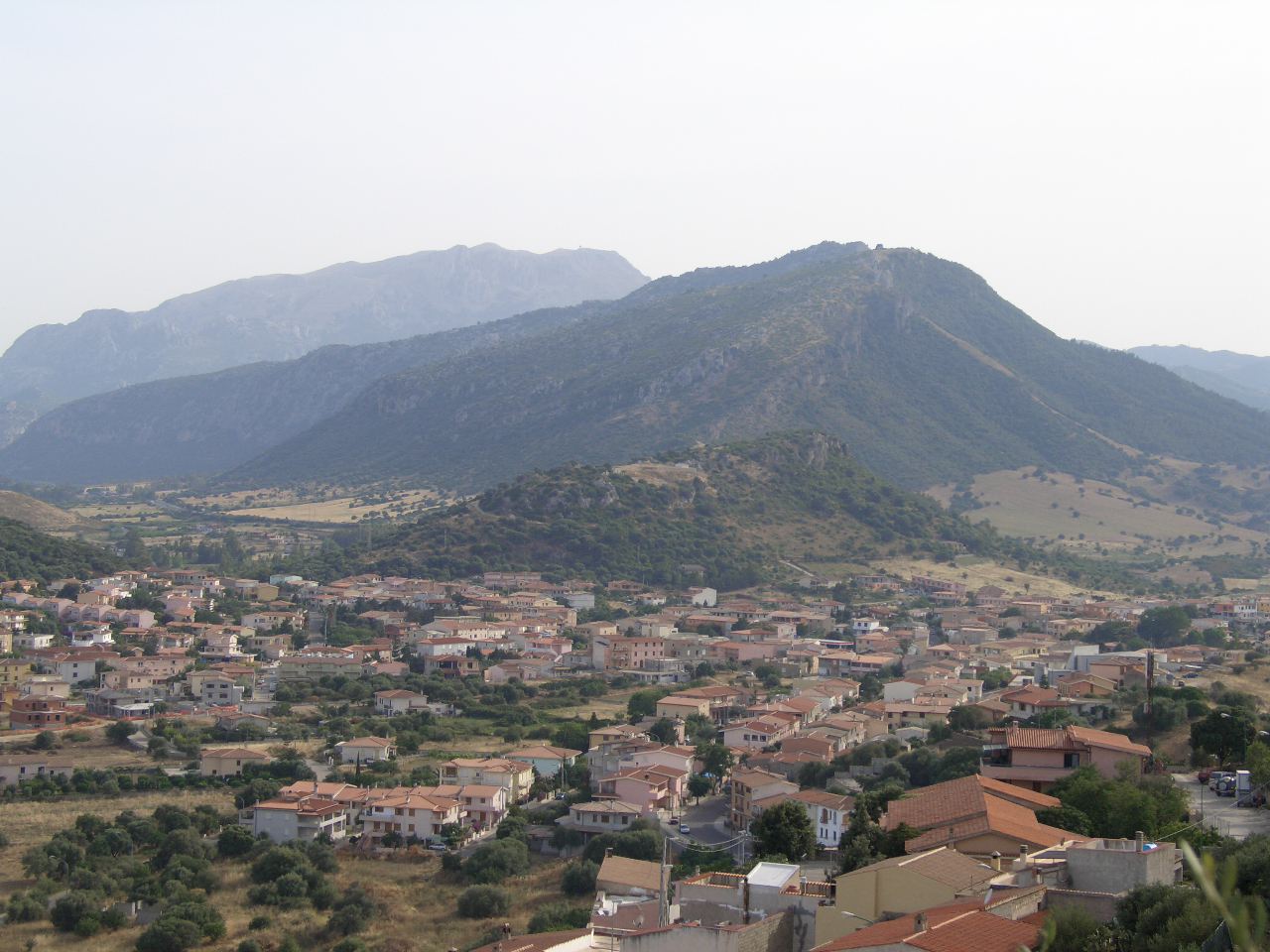
Happily, easyJet flies from Berlin Schoenefeld to Olbia on the Italian island of Sardinia. We had booked ourselves into a cosy Bed & Breakfast place in the North of the island, and a snazzy little rental car to move around. While he had planned to keep our excursions to the Northern part of the island, it turned out we had underestimated the curviness of the roads. It was difficult to drive anywhere much faster than 40 mph or something (except on a few stretches of highway), so our action radius was somewhat curtailed. We did manage to see quite a bit of the rugged beauty and historic treasures, and it was a wonderful and relaxing 8 days.
Here's a few pictures that attempt to capture a little of what we saw:



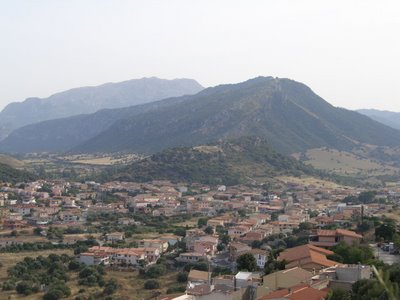

Happily, easyJet flies from Berlin Schoenefeld to Olbia on the Italian island of Sardinia. We had booked ourselves into a cosy Bed & Breakfast place in the North of the island, and a snazzy little rental car to move around. While he had planned to keep our excursions to the Northern part of the island, it turned out we had underestimated the curviness of the roads. It was difficult to drive anywhere much faster than 40 mph or something (except on a few stretches of highway), so our action radius was somewhat curtailed. We did manage to see quite a bit of the rugged beauty and historic treasures, and it was a wonderful and relaxing 8 days.
Here's a few pictures that attempt to capture a little of what we saw:



How time flies when you're having fun
Oh my goodness, as Shirley Temple used to say so fetchingly... how time flies! Looks like I haven't blogged in month or so... thereby sorely trying the patience of my multitude of readers. ANd I hope they will accept as excuses any or all of the following:
- it was HOT here, and a sticky heat at that, so I hardly was able to function, let alone think up new blog entries;
- my birthday came and went, plunging me into midlife depression for a while;
- Andrea and I treated ourselves to a week of vacation on Sardinia, where I was blessedly away from the world wide web though not from the heat;
- upcoming exams kept me studying morning, noon, and night;
- did I mention it was HOT?
Anyway, I'll try to come up with some new stuff to share. First will be a few vacation pics.
- it was HOT here, and a sticky heat at that, so I hardly was able to function, let alone think up new blog entries;
- my birthday came and went, plunging me into midlife depression for a while;
- Andrea and I treated ourselves to a week of vacation on Sardinia, where I was blessedly away from the world wide web though not from the heat;
- upcoming exams kept me studying morning, noon, and night;
- did I mention it was HOT?
Anyway, I'll try to come up with some new stuff to share. First will be a few vacation pics.
Friday, May 26, 2006
Gold ships and silver ships
A line from a novel I read over 20 years ago remains stuck in my mind:
"There are gold ships and silver ships, but the best ship is friendship."
Corny, isn't it? And I don't even know if it's a well-known saying, or just something the author Joseph Heller made up. But I've been thinking about friendships and what they mean to me. Apparently, not a whole lot, because I don't really have a large circle of friends...and, as the recent high school graduation anniversary reminded me, I certainly don't have very many longtime friends, not from my school days, at any rate. Part of that is to be expected, I suppose, and not really specific to me. People tend to drift apart once they enter new spheres of life. When you enter university, when you start out in a job, and then again a new job, when you marry, when you have children, every new sphere brings new relationships, most often at the expense of older ones.
A lot depends on your personal definition (or, as I like to say as a card-carrying constructivist, your personal construction) of friendship. I suppose your relationships with other people could be plotted on a continuum that could have the poles of "enemy" vs. "friend", or of "completely indifferent person" vs. "really close and intimate friend", with loose acquaintances somewhere in between.
Another dimension is likely to be your personality. Are you an extravert who is outgoing and sociable, if perhaps a little superficial, someone who likes to have many friends around? Or rather an introvert who prefers few but deep friendships but who is just as happy not to have his friends around all the time?
When I look at my own preferences, I find that I want to be friends with many, but I also want to be left alone; I relish the lively exchange of ideas with other people, but I admit to preferring the company of a good book to a crowd of friends.
In all honesty, I also find that most friendships can turn boring all too soon. Conversations with longtime friends tend to be predictable; if you haven't seen them in a while and then meet them again, you mentally "check off" the relevant topics of discussion (family, job etc. ) but rarely cover new ground. But I realize that, much as marriage, friendship needs work, needs input. You can't expect your friends to be there for you if you never are there for them, even if just for listening. It has to be a two-way street.
So, to return to the trite phrase from the beginning, it may be that true and deep friendship is better than any gold or silver ship could be. But you have to work to keep that ship afloat; if you're not prepared to do that, you may as well leave the ship in the harbor. ((I think I now have flogged the ship metaphor to death) )
"There are gold ships and silver ships, but the best ship is friendship."
Corny, isn't it? And I don't even know if it's a well-known saying, or just something the author Joseph Heller made up. But I've been thinking about friendships and what they mean to me. Apparently, not a whole lot, because I don't really have a large circle of friends...and, as the recent high school graduation anniversary reminded me, I certainly don't have very many longtime friends, not from my school days, at any rate. Part of that is to be expected, I suppose, and not really specific to me. People tend to drift apart once they enter new spheres of life. When you enter university, when you start out in a job, and then again a new job, when you marry, when you have children, every new sphere brings new relationships, most often at the expense of older ones.
A lot depends on your personal definition (or, as I like to say as a card-carrying constructivist, your personal construction) of friendship. I suppose your relationships with other people could be plotted on a continuum that could have the poles of "enemy" vs. "friend", or of "completely indifferent person" vs. "really close and intimate friend", with loose acquaintances somewhere in between.
Another dimension is likely to be your personality. Are you an extravert who is outgoing and sociable, if perhaps a little superficial, someone who likes to have many friends around? Or rather an introvert who prefers few but deep friendships but who is just as happy not to have his friends around all the time?
When I look at my own preferences, I find that I want to be friends with many, but I also want to be left alone; I relish the lively exchange of ideas with other people, but I admit to preferring the company of a good book to a crowd of friends.
In all honesty, I also find that most friendships can turn boring all too soon. Conversations with longtime friends tend to be predictable; if you haven't seen them in a while and then meet them again, you mentally "check off" the relevant topics of discussion (family, job etc. ) but rarely cover new ground. But I realize that, much as marriage, friendship needs work, needs input. You can't expect your friends to be there for you if you never are there for them, even if just for listening. It has to be a two-way street.
So, to return to the trite phrase from the beginning, it may be that true and deep friendship is better than any gold or silver ship could be. But you have to work to keep that ship afloat; if you're not prepared to do that, you may as well leave the ship in the harbor. ((I think I now have flogged the ship metaphor to death) )
Friday, May 19, 2006
Apropos of the rainy weather
Biking through the pouring rain yesterday, it helped that a bouncy little song was playing and re-playing in my head... no, it wasn't the all-too-obvious "Singin' In The Rain", though that is of course a beautiful standard. (And I do have a Judy Garland, up-tempo version of it somewhere, which I really need to listen to again sometime)
It was a song from the Disney live-action classic, "In Search of the Castaways", from 1962, which also happens to be the year of my birth. The Jules Verne-based film had an eclectic cast including George Sanders, the bubbly Hayley Mills and... Maurice Chevalier.
Chevalier and Mills together sang the song I'm referring to, a buoyant little number by Walt Disney's all-purpose songwriters, the Sherman brothers.
I'm quoting from memory here:
Why cry about bad weather? Enjoy it!
Each moment is a treasure, enjoy it!
We're travelers on life's highway, enjoy the trip!
Each lovely twist and byway, each bump and dip!
When there's a complication, enjoy it -
you've got imagination, employ it!
A hurrican comes your way? Enjoy the breeze!
You're stranded in the jungle? Enjoy the trees!
(there's more, about seeing roses in the snow, and "joie de vivre" making them grow,
but I always sing that first part ;)
And you know what? It worked - I really enjoyed getting wet all the way to my unmentionables :)
It was a song from the Disney live-action classic, "In Search of the Castaways", from 1962, which also happens to be the year of my birth. The Jules Verne-based film had an eclectic cast including George Sanders, the bubbly Hayley Mills and... Maurice Chevalier.
Chevalier and Mills together sang the song I'm referring to, a buoyant little number by Walt Disney's all-purpose songwriters, the Sherman brothers.
I'm quoting from memory here:
Why cry about bad weather? Enjoy it!
Each moment is a treasure, enjoy it!
We're travelers on life's highway, enjoy the trip!
Each lovely twist and byway, each bump and dip!
When there's a complication, enjoy it -
you've got imagination, employ it!
A hurrican comes your way? Enjoy the breeze!
You're stranded in the jungle? Enjoy the trees!
(there's more, about seeing roses in the snow, and "joie de vivre" making them grow,
but I always sing that first part ;)
And you know what? It worked - I really enjoyed getting wet all the way to my unmentionables :)
Wednesday, May 17, 2006
Sticks and stones may break bones, but words can also hurt
I apologize for making this a more personal post than usual... on second thoughts, what am I apologizing for? Aren't Blogs supposed to be personal?
As I mentioned in my last post, I attended a high school reunion last weekend, my first ever. It was interesting to see how my former classmates had changed and matured, in appearance as well as in outlook. But while I had been prepared for the usual questions about what my life had been like in the intervening years, what career choices I've made and so on, I was not prepared when a former classmate confronted me with a description of my older self that was anything but positive.
My own memories of school are hazy and selective, and while I remembered having had political differences and debates with that classmate, my take on them was that it had all been in good fun of the "agree to disagree" variety. However, her recollection was much different, and much as I want to believe my version, I fear hers may be the more accurate one, especially as she felt so strongly about it that this impression of me virtually stayed with her through the years. I should add that this classmate is of Indian heritage, and as she told me, my statements in class and to her had clearly been racist. And while she had encountered "faceless" racism and intolerance before and elsewhere, to her I became the face of racism.
I can't really say strongly enough how much that distressed me. There are few things I despise more or find more repugnant than racism, intolerance, or discrimination of any sort. My own self image all these years has been of a person remarkably free of prejudice, someone who truly believes that all people are basically brothers and sisters, all children of a loving God. The idea of demeaning or belittling someone on account of their color, race, ethnicity or religion is completely alien to me...now. And I am deeply ashamed that I ever may have acted or believed differently.
But the more salient point here is that our own perception of ourselves, and of how we act in certain situations, may be much different from how others perceive us. A careless remark, possibly meant in fun, can hurt deeply... never more so than during the formative years of young personhood, where one is still searching for one's own identity. And young people can be especially cruel and harsh in their views of others.
I hope and I think that my classmate realized that I've changed from the person who made all these statements in the past, whether they ever were intentionally racist or not. And I believe the lesson here is very easy...and very hard at the same time: the things we do, the things we say, leave traces in the people around us. And while it is unrealistic to expect that we will always be able to consider every possible consequence of our acts, it sometimes may be good policy to remember the old saying that "if you can't say anything nice, say nothing at all", or, because disagreement is a healthy and necessary thing, to at least be civil about it.
As I mentioned in my last post, I attended a high school reunion last weekend, my first ever. It was interesting to see how my former classmates had changed and matured, in appearance as well as in outlook. But while I had been prepared for the usual questions about what my life had been like in the intervening years, what career choices I've made and so on, I was not prepared when a former classmate confronted me with a description of my older self that was anything but positive.
My own memories of school are hazy and selective, and while I remembered having had political differences and debates with that classmate, my take on them was that it had all been in good fun of the "agree to disagree" variety. However, her recollection was much different, and much as I want to believe my version, I fear hers may be the more accurate one, especially as she felt so strongly about it that this impression of me virtually stayed with her through the years. I should add that this classmate is of Indian heritage, and as she told me, my statements in class and to her had clearly been racist. And while she had encountered "faceless" racism and intolerance before and elsewhere, to her I became the face of racism.
I can't really say strongly enough how much that distressed me. There are few things I despise more or find more repugnant than racism, intolerance, or discrimination of any sort. My own self image all these years has been of a person remarkably free of prejudice, someone who truly believes that all people are basically brothers and sisters, all children of a loving God. The idea of demeaning or belittling someone on account of their color, race, ethnicity or religion is completely alien to me...now. And I am deeply ashamed that I ever may have acted or believed differently.
But the more salient point here is that our own perception of ourselves, and of how we act in certain situations, may be much different from how others perceive us. A careless remark, possibly meant in fun, can hurt deeply... never more so than during the formative years of young personhood, where one is still searching for one's own identity. And young people can be especially cruel and harsh in their views of others.
I hope and I think that my classmate realized that I've changed from the person who made all these statements in the past, whether they ever were intentionally racist or not. And I believe the lesson here is very easy...and very hard at the same time: the things we do, the things we say, leave traces in the people around us. And while it is unrealistic to expect that we will always be able to consider every possible consequence of our acts, it sometimes may be good policy to remember the old saying that "if you can't say anything nice, say nothing at all", or, because disagreement is a healthy and necessary thing, to at least be civil about it.
Monday, May 15, 2006
Home is where the heart is
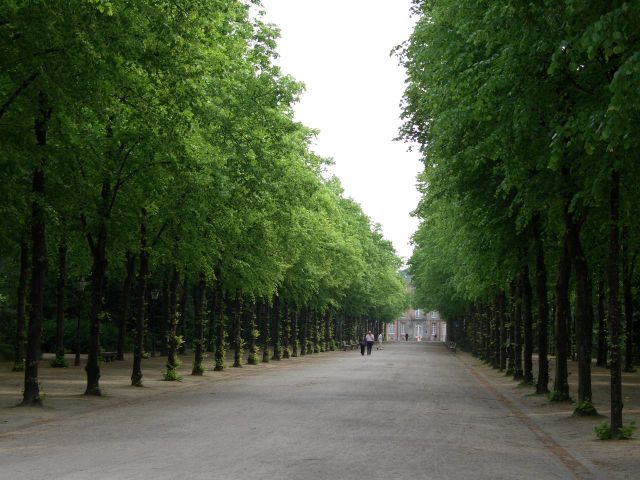
Last weekend, I attended my *cough, cough* 25th high-school graduation anniversary back in my hometown of Duesseldorf... to protect the innocent and prematurely aged, I won't be posting pics from the reunion, but I'll post a few of the 100s of pics I took while visiting the city for the first time in 5 years. Besides a few shots of the city, here's your chance to not only see a duck from below, and a crane that looks like a horse's head (at least to me it does!), but also a rare one of my wife and me :)
Here goes:










Here goes:













Monday, May 08, 2006





Saturday, April 22, 2006
What's YOUR mindset?
I’ve decided to focus a little more on psychology, and to feature –time permitting- some aspects, theories, and people in psychology that I find particularly interesting and enriching.
Stanford psychologist Carol Dweck has recently published a book that distills her research into what she calls “implicit theories” or mindsets that appear to determine much of how we function. Her central proposal is that people either hold a fixed mindset or a growth mindset (earlier works by her featured the description of “entity theories” or “incremental theories”). Simply put, a fixed mindset is one in which you view your talents and abilities (e.g., your intelligence) as basically fixed, stable, and unchangeable. The person with such a mindset believes he or she is who he or she is, and that the ideal way of getting through life is to avoid challenge and the risk of failure.
If, on the other hand, you have a growth mindset, you see yourself as a fluid entity, a work in progress, and you welcome challenges as opportunities rather than risks.
To someone who holds the one or the other of those mindsets, it appears natural and he or she may be surprised that there is that other way of looking at things. But Dweck’s research showed that as early as kindergarten, people split up among those two central mindsets. The good news is that even fixed mindsets are not set in granite, they can be changed. Dweck's overall assertion that rigid thinking benefits no one, least of all yourself, and that a change of mind is always possible, is welcome.
The book is filled with an avalanche of vivid stories from lives of the ordinary and the celebrated in the worlds of business, science, education and sports. Each chapter is filled with anecdotes from everyday people as well as names still making headlines today, demonstrating how a fixed mindset can constrict a life while a growth mindset can liberate and empower one. The author even turns the lens of her criticism to her own life, reviewing not only her successes but also the failings and her struggles to apply the insights she's exploring.
While each chapter also ends with a checklist for evaluating one's own mindset and its life consequences and there's something of a primer for shifting mindsets at the end, this is not merely a how-to manual. But merely reading the book (and it's a quick 255 pages) begins building the recognition skills the author stresses as an important first step to making changes in one's own life. And as she points out, it's never too late to change a mindset that is limiting one's potential and accomplishment in any aspect of life, including love and relationships. For those of us who are parents, or teachers, or in relationships, the book also shows that there right kinds and wrong kinds of praise and criticism, namely, those kinds that encourage growth and those that don’t.
Here’s a link that I hope will work for you (if not, just go to www.amazon.com or www.barnesandnoble.com or whatever and search for Carol Dweck)
http://www.amazon.com/gp/product/1400062756/sr=8-1/qid=1145700975/ref=pd_bbs_1/103-0938507-7987029?%5Fencoding=UTF8
Stanford psychologist Carol Dweck has recently published a book that distills her research into what she calls “implicit theories” or mindsets that appear to determine much of how we function. Her central proposal is that people either hold a fixed mindset or a growth mindset (earlier works by her featured the description of “entity theories” or “incremental theories”). Simply put, a fixed mindset is one in which you view your talents and abilities (e.g., your intelligence) as basically fixed, stable, and unchangeable. The person with such a mindset believes he or she is who he or she is, and that the ideal way of getting through life is to avoid challenge and the risk of failure.
If, on the other hand, you have a growth mindset, you see yourself as a fluid entity, a work in progress, and you welcome challenges as opportunities rather than risks.
To someone who holds the one or the other of those mindsets, it appears natural and he or she may be surprised that there is that other way of looking at things. But Dweck’s research showed that as early as kindergarten, people split up among those two central mindsets. The good news is that even fixed mindsets are not set in granite, they can be changed. Dweck's overall assertion that rigid thinking benefits no one, least of all yourself, and that a change of mind is always possible, is welcome.
The book is filled with an avalanche of vivid stories from lives of the ordinary and the celebrated in the worlds of business, science, education and sports. Each chapter is filled with anecdotes from everyday people as well as names still making headlines today, demonstrating how a fixed mindset can constrict a life while a growth mindset can liberate and empower one. The author even turns the lens of her criticism to her own life, reviewing not only her successes but also the failings and her struggles to apply the insights she's exploring.
While each chapter also ends with a checklist for evaluating one's own mindset and its life consequences and there's something of a primer for shifting mindsets at the end, this is not merely a how-to manual. But merely reading the book (and it's a quick 255 pages) begins building the recognition skills the author stresses as an important first step to making changes in one's own life. And as she points out, it's never too late to change a mindset that is limiting one's potential and accomplishment in any aspect of life, including love and relationships. For those of us who are parents, or teachers, or in relationships, the book also shows that there right kinds and wrong kinds of praise and criticism, namely, those kinds that encourage growth and those that don’t.
Here’s a link that I hope will work for you (if not, just go to www.amazon.com or www.barnesandnoble.com or whatever and search for Carol Dweck)
http://www.amazon.com/gp/product/1400062756/sr=8-1/qid=1145700975/ref=pd_bbs_1/103-0938507-7987029?%5Fencoding=UTF8
Tuesday, April 04, 2006
Sex tourism within the U.S.
http://news.yahoo.com/s/nm/20060404/us_nm/crime_sextourism_dc
Reading this truly made me heartsick... now, studying to be a psychologist makes me aware that the sexual drive is a powerful one, and as a constructivist I believe that people do construct their own realities... but I for one can't imagine a reality in which there can be any pleasure in demeaning and abusing a child.
Reading this truly made me heartsick... now, studying to be a psychologist makes me aware that the sexual drive is a powerful one, and as a constructivist I believe that people do construct their own realities... but I for one can't imagine a reality in which there can be any pleasure in demeaning and abusing a child.
Wednesday, March 29, 2006
O is for Onomatopoeia

hehe! fill all your onomatopoeic needs right here:
http://www.batmania.com.ar/paginas/serie_onomatopeyas.htm
Monday, March 20, 2006
Disney legend Ollie Johnston
Hmmm... I guess I haven't posted in a few days, and since I know teeming multitudes have been waiting with bated breath for new insight from me, I'd better get on it pronto!
Before I start, and before any of you lose interest, I just want to put in a quick plug for an excellent blog about the making of a new animated movie based on the Irish Book of Kells,
http://theblogofkells.blogspot.com
And that set me thinking about how I love animation...and how I've been fortunate to know one of the premier Disney legends, Oliver M. Johnston or Ollie Johnston, one of Walt Disney's Nine Old Men...in fact, the last surviving one.
Picture shows Old Men Marc Davis, Frank Thomas, Ollie Johnston and Ward Kimball
Now in his 94th year, Ollie joined Disney in the 1930s, learning the ropes mostly under greats such as Art Babitt and, especially, Fred Moore. He soon became a supervising animator. While the animation process at Disney was a collaborative effort and it therefore is not technically correct to credit just one person with the design of a character, Ollie was largely responsible for bringing to life many classic Disney stars, such as Mr. Smee, Alice (in Wonderland), Baloo the bear, the three good fairies in Sleeping Beauty, and many others... in the last picture he actively worked on, The Rescuers, he even sneaked in a caricature of himself, in the shape of Rufus, the orphanage cat that comforts little Penny.
 Ollie lookalike Rufus the Cat on the bed
next to Lil Orphan Penny - see the resemblance?
I had the good fortune of meeting Frank and his wife, Marie (who sadly passed away last year) more than 20 years ago... I was living in my hometown of Düsseldorf at the time. It was a pleasure spending time with that gracious couple. Later, I met Ollie again in Burbank, California...and we kept a loose pen-palship over the years.
Someday, when blogger photo uploads work properly again for me, I'll post some of the
wonderful X-mas cards he's sent me.
Even though I sometimes feel OLD at 43-and-a-half, I can't even begin what it must be like to be approaching 94... to have lived through such amazing times, to have spent 60+ years with a woman and then to lose her... to have left this rich and wonderful legacy of artwork...
here's to you, Ollie!
Before I start, and before any of you lose interest, I just want to put in a quick plug for an excellent blog about the making of a new animated movie based on the Irish Book of Kells,
http://theblogofkells.blogspot.com
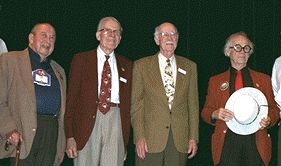
And that set me thinking about how I love animation...and how I've been fortunate to know one of the premier Disney legends, Oliver M. Johnston or Ollie Johnston, one of Walt Disney's Nine Old Men...in fact, the last surviving one.
Picture shows Old Men Marc Davis, Frank Thomas, Ollie Johnston and Ward Kimball
Now in his 94th year, Ollie joined Disney in the 1930s, learning the ropes mostly under greats such as Art Babitt and, especially, Fred Moore. He soon became a supervising animator. While the animation process at Disney was a collaborative effort and it therefore is not technically correct to credit just one person with the design of a character, Ollie was largely responsible for bringing to life many classic Disney stars, such as Mr. Smee, Alice (in Wonderland), Baloo the bear, the three good fairies in Sleeping Beauty, and many others... in the last picture he actively worked on, The Rescuers, he even sneaked in a caricature of himself, in the shape of Rufus, the orphanage cat that comforts little Penny.
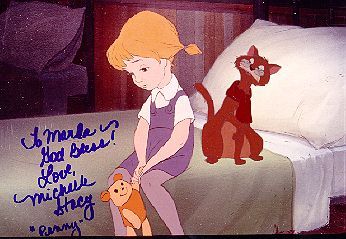 Ollie lookalike Rufus the Cat on the bed
next to Lil Orphan Penny - see the resemblance?
I had the good fortune of meeting Frank and his wife, Marie (who sadly passed away last year) more than 20 years ago... I was living in my hometown of Düsseldorf at the time. It was a pleasure spending time with that gracious couple. Later, I met Ollie again in Burbank, California...and we kept a loose pen-palship over the years.
Someday, when blogger photo uploads work properly again for me, I'll post some of the
wonderful X-mas cards he's sent me.
Even though I sometimes feel OLD at 43-and-a-half, I can't even begin what it must be like to be approaching 94... to have lived through such amazing times, to have spent 60+ years with a woman and then to lose her... to have left this rich and wonderful legacy of artwork...
here's to you, Ollie!
Tuesday, March 14, 2006
Abominations
In his current book, "What Jesus Meant", writer (and practicing Catholic) Garry Wills quotes a letter that someone sent via the internet to an Evangelical preacher, who had raged against the "abomination" of homosexuality. I reproduce the letter below, condensed.
"Thank you for doing so much to educate people regarding God's law. I have learned a great deal from you, and try to share that knowledge with as many people as I can. When someone tries to defend the homosexual lifestyle, for example, I simply remind them that Leviticus 18:22 clearly states it to be an abomination--end of debate. I do need some advice from you, however, regarding some other elements of God's laws and how to follow them.
Leviticus 25:44 states that I may possess slaves, both male and female, provided they are purchased from neighboring nations. A friend of mine claims that this applies to Mexicans but not Canadians. Can you clarify? Why can't I own Canadians?
I would like to sell my daughter into slavery, as sanctioned in Exodus 21:7. In this day and age, what do you think would be a fair price for her?
When I burn a bull on the altar as a sacrifice, I know it creates a pleasing odor to the Lord (Lev. 1:9). The problem is my neighbors. They claim the odor is not pleasing to them. Should I smite them?
A friend of mine feels that even though eating shellfish is an abomination (Lev. 11:10), it is a lesser abomination than homosexuality. I don't agree. Can you settle this? Are there degrees of abomination?
Leviticus 21:20 states that I may not approach the altar of God if I have a defect in my eyesight. I have to admit that I wear glasses. Does my vision have to be 20/20, or is there some wiggle room here?
I know from Leviticus 11:6-8 that touching the skin of a dead pig makes me unclean, but may I still play football if I wear gloves?"
(end of quote)
The idea of abomination arose from the fear of the "unclean," which in turn arose from the fear of the "unnatural." One whole class of the "unnatural" entails the mixing of different kinds of things--of milk and meat, for instance, or planting two different kinds of seed in the same field, or mingling two kinds of yarn in the same garment (Lev. 19:19). Another class of the "unnatural" has to do with the idea of function: the function of eating is to sustain bodily life, the function of sex is procreation, and so on.
Yet it is quite acceptable, even among Christian fundamentalists, to extend eating beyond survival to celebration and fellowship. Why, then, cannot sex be extended beyond procreation to an ideal of intimate communion between two individuals? Two individuals of the opposite sex, of course. But why not also of the same sex? After all, with same sex, one obeys the old tribal law of "not mixing different kinds of things" (Garry Wills, What Jesus Meant, 2006, pp. 32-39).
note: this entire post lifted with all due respect from noted geographer Yi-Fu Tuan's homepage, http://www.geography.wisc.edu/~yifutuan/
"Thank you for doing so much to educate people regarding God's law. I have learned a great deal from you, and try to share that knowledge with as many people as I can. When someone tries to defend the homosexual lifestyle, for example, I simply remind them that Leviticus 18:22 clearly states it to be an abomination--end of debate. I do need some advice from you, however, regarding some other elements of God's laws and how to follow them.
Leviticus 25:44 states that I may possess slaves, both male and female, provided they are purchased from neighboring nations. A friend of mine claims that this applies to Mexicans but not Canadians. Can you clarify? Why can't I own Canadians?
I would like to sell my daughter into slavery, as sanctioned in Exodus 21:7. In this day and age, what do you think would be a fair price for her?
When I burn a bull on the altar as a sacrifice, I know it creates a pleasing odor to the Lord (Lev. 1:9). The problem is my neighbors. They claim the odor is not pleasing to them. Should I smite them?
A friend of mine feels that even though eating shellfish is an abomination (Lev. 11:10), it is a lesser abomination than homosexuality. I don't agree. Can you settle this? Are there degrees of abomination?
Leviticus 21:20 states that I may not approach the altar of God if I have a defect in my eyesight. I have to admit that I wear glasses. Does my vision have to be 20/20, or is there some wiggle room here?
I know from Leviticus 11:6-8 that touching the skin of a dead pig makes me unclean, but may I still play football if I wear gloves?"
(end of quote)
The idea of abomination arose from the fear of the "unclean," which in turn arose from the fear of the "unnatural." One whole class of the "unnatural" entails the mixing of different kinds of things--of milk and meat, for instance, or planting two different kinds of seed in the same field, or mingling two kinds of yarn in the same garment (Lev. 19:19). Another class of the "unnatural" has to do with the idea of function: the function of eating is to sustain bodily life, the function of sex is procreation, and so on.
Yet it is quite acceptable, even among Christian fundamentalists, to extend eating beyond survival to celebration and fellowship. Why, then, cannot sex be extended beyond procreation to an ideal of intimate communion between two individuals? Two individuals of the opposite sex, of course. But why not also of the same sex? After all, with same sex, one obeys the old tribal law of "not mixing different kinds of things" (Garry Wills, What Jesus Meant, 2006, pp. 32-39).
note: this entire post lifted with all due respect from noted geographer Yi-Fu Tuan's homepage, http://www.geography.wisc.edu/~yifutuan/
Sunday, March 12, 2006
Acid attacks
 Is it possible for a person to literally "melt", to dissolve? To have your beauty, your future, your life melt away is what literally happens to thousands of (mostly) girls and women, who are doused with acid... in their sleep... by men.
Like Nobisa, a 15-year old, who made the mistake of telling a boy she didn't love him. Or Nasima, who was just 12 when she turned down a marriage proposal by her 27-year old uncle.
Or the heart-wrenching case of the young mother who arrived at a clinic with her 10-month old baby. Her husband had been brutal and violent even during the pregnancy, had raged and demanded the outstanding rest of the dowry, had hit and beaten his young wife. After the child had been born, he had attacked it no less than five times with acid, once even forcing the baby to swallow some. Finally, the mother was able to flee with her child.
A small amount of sulphuric or hydrochloric acid, readily available even to the poorest, can disfigure within minutes. The substance not only eats into the skin on face, neck and shoulders but also the underlying muscles and nerves, sometimes even the bone. Immediate help is essential, yet 80 percent of such attacks occur in remote rural areas, where the trip to the next doctor or hospital is at best an adventure. And even if you have found a doctor who knows how to treat the terrible, disfiguring wounds, the damage to the spirit and the soul is harder, if not impossible to repair.
Not only do the victims suffer almost unbearable pain and anguish, their lives are also thrown off course, with love and marriage now a near impossibility. Education is cut short, with all physical and financial resources now poured into trying to recover.
"It's difficult to tell what it is that goes through the mind of someone who throws skin-burning acid over another human being," said Dr Ron Hiles, a British plastic surgeon who recently travelled to Bangladesh to treat acid attack survivors. "There are all sorts of motivations, one of the prime ones being jealousy. But I don't think people realise before they carry out the attack quite what horrific injuries they will cause."
I'm not ashamed to say that tears ran down my face as I read about the plight of these women, whose lives have been ruined by cowardly, evil attacks. And I salute them for their strength and power of will, and their refusal to let the attack destroy their identities. As it happens, Monira Rahman, who works to help the victims will receive the Human Rights Prize from Amnesty International here in Berlin March 19th . Her organization is www.acidsurvivors.org and I hope some who read this will be moved to pledge some financial support for that cause.
Yes, we need to acknowledge that different cultures have different norms and traditions. But, much as the practice of genital mutilation, the reprehensible tradition of acid attacks needs to be stopped. Sadly, however, it appears to be spreading, as this news report from Iraq says http://www.kurdmedia.com/news.asp?id=7197
Friday, March 10, 2006
A Teltow Friday

Self-portrait :)
Taking a short walk this morning, I experienced the pretty side of Winter once more. Overnight, some snow had softly fallen, and it kept on snowing all morning. With my trusty digital camera always at the ready, I took a few pictorial impressions (I had to re-size them a little bit; you'll have to take my word for it that they look better in large format) :










Subscribe to:
Posts (Atom)
